The Micrology of a Vanished Gesture
I.
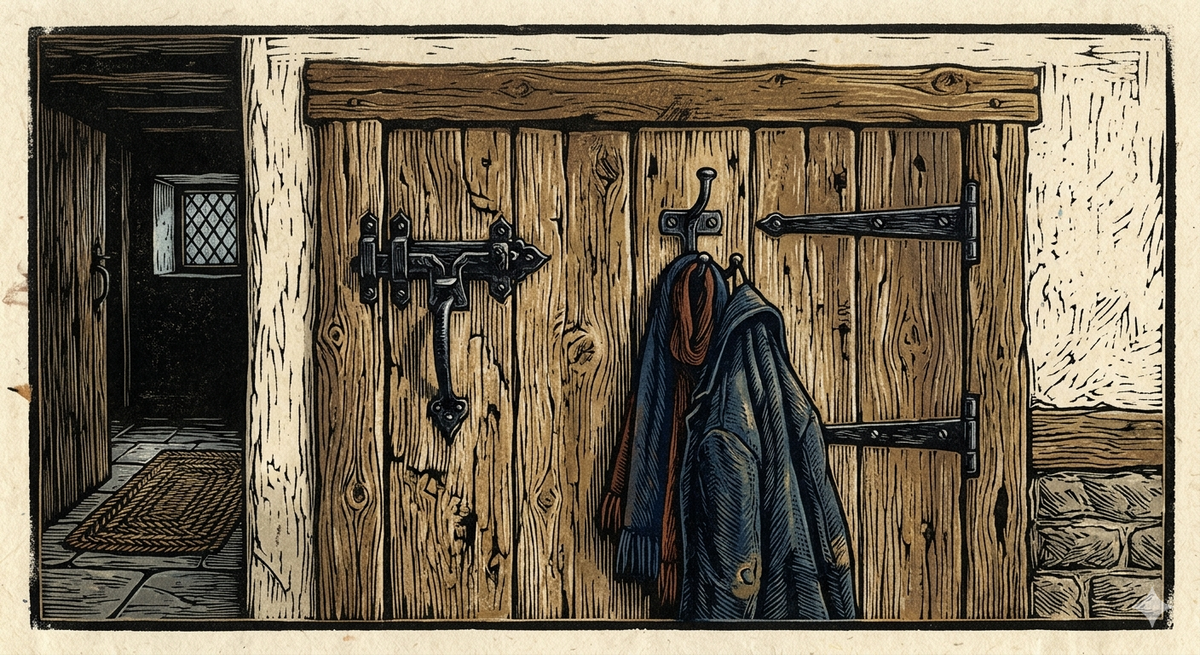
The coat hook on the back of the restroom stall door was, for the duration of its tenure, a small act of civilization addressed to the stranger. It said: you will need both hands. It said: what you carry may be set aside for a moment. It presupposed a subject, one burdened, purposive, deserving of a momentary reprieve from the weight of things. To enter and find the hook was to be anonymously recognized.
Its removal rescinded that recognition. And the reasons given for its removal are a small catechism of the administered world.
II.
The NY/NJ Port Authority’s logic was impeccable in the way administrative logic always is: impeccable, airless, and lethal. Coat hooks enabled theft. Coat hooks enabled shelter. Therefore coat hooks were removed. The syllogism amputated the entire dimension of innocent use along with the criminal opportunity. The hook is abolished in its totality so that its abuse becomes impossible. This is the administrative solution to every problem of misuse: eliminate the thing misused.
The thief and the man sleeping in the stall never intended to destroy the hook’s ordinary meaning. The Port Authority destroyed it on their behalf and charged the destruction to their accounts.
That the hook could serve as the armature of a makeshift dwelling, a bag draped over it, a coat hung across the gap, temporary walls fashioned from the materials of transit, was read as cunning, as abuse, as a problem to be engineered away. Yet what this improvisation actually was, in extremis, was the minimum expression of the human need to make a place within a place, to subdivide hostile space into something, however fleetingly, one’s own.
The unhoused person was doing, with desperate ingenuity, precisely what Adorno mourns throughout Minima Moralia: dwelling. Not owning. Not consuming. Relating to space as something other than a throughput mechanism.
The hook, meant only for transit, became the last domestic fixture available. And because it became domestic for them, it was taken from everyone.
III.
The coat hook and the doorknob are dialectical twins, though only the doorknob received Adorno’s explicit, if oblique, attention. In the shift from the gentle latch (sanfte Klinke) that a hand might meet with something like courtesy to the turnable handle that demands the hand’s full rotational submission, Adorno saw the object cease to negotiate and begin to command. The old latch bore in its shape the accumulated memory of how bodies prefer to move. The modern handle has only a function.
The coat hook belongs to the world of the gentle latch. Angular, particular, non-universal, it does not ask the hand to conform; it asks only that something be draped upon it, quietly, without insistence. You could ignore it entirely. That optionality was part of its grace. An object that can be ignored retains something of the human scale.
The smooth door without a hook makes no such offer. It is finished surface all the way down. Nothing adheres. Nothing lingers. The interaction is instantaneous and leaves no trace, which is what the administered world means by efficiency, and what it means, in a different register, by loneliness.
IV.
What was lost was not convenience, a word that now belongs entirely to the vocabulary of frictionless adaptation. What was lost was a moment of discontinuity in public space: the brief acknowledgment that the person entering carried a before and an after, was not simply a body occupying a stall but a traveler, a worker, someone hauling the weight of the day.
Without the hook the gesture becomes awkward and slightly humiliating. The bag balanced on the lap, wedged between feet, or set on the filthy floor. The small dignity of unburdening, of arriving, however momentarily, as a person rather than a user of facilities, vanishes. Public space no longer offers such pauses.
The seat engineered to prevent sleeping, the armrest deployed as a divider, the surface angled to shed the recumbent body: these are the positive content of what the hook’s removal expresses negatively. The goal is throughput. The goal is that no one remains. The goal is the abolition of the interval in which a space might become, however briefly, a place.
Against this, the old hook was a form of resistance so mild as to be almost invisible, the resistance of a thing that assumed you would stay long enough to need it.
V.
There is a particular poignancy in the fact that the hook broke under the weight of what people now carry, laptops, chargers, the whole apparatus of precarious portable work, and was not replaced. This is not metaphor but literal history, the kind Adorno’s method insists upon reading. The hook was stressed beyond its design. The response was silence. No repair. No replacement. Only a hole in the door, a faint shadow on the paint, or nothing at all, not even an absence marked.
This is how the administered world handles the failures of its infrastructure when that infrastructure serves no profitable function: not with decisive removal, which would at least be an act, but with neglect, which requires none. The violence is bureaucratic, distributed, deniable, the product of a system that has simply ceased to include certain human needs in its calculations. The hook disappears by degrees, by accumulated non-attention, until it is gone and no one can say exactly when.
VI.
To restore the hook would not be nostalgia. Adorno is merciless on nostalgia, which he reads as the false reconciliation of a subject unable to bear the negativity of the present. Nor would restoration be a design intervention, with its cheerful implication that the problem is merely aesthetic and the solution a better fixture.
It would be a small insistence that public space is not exhausted by its function, that the stranger carries things, that those things may be briefly set aside, that this setting-aside is a human act worthy of accommodation. The hook is a claim about the person who enters: that they are burdened, that burdens may be put down, that the space knows this and has made provision. Its absence is the counter-claim: that the person entering is simply a body among bodies, anonymous in the most reductive sense. Not the anonymity of the city that preserves freedom, but the anonymity of the processing center that has forgotten there is anything left to preserve.
To hang something on a hook is to arrive. To find no hook is to have never, in any sense the space acknowledged, been there at all.
In the administered world the stranger is no longer presumed to be a person in transit, only a body in process. The hook’s quiet offer, that you may linger just long enough to unburden, was one of the last polite fictions of public life. Its absence leaves the fiction exposed. The smallest gesture of recognition has been optimized away, and with it a fragment of what it once meant to move through the world as someone who might, for a moment, set the weight down.