Trump is Back in Tbilisi: The Questions from 2017 Never Left
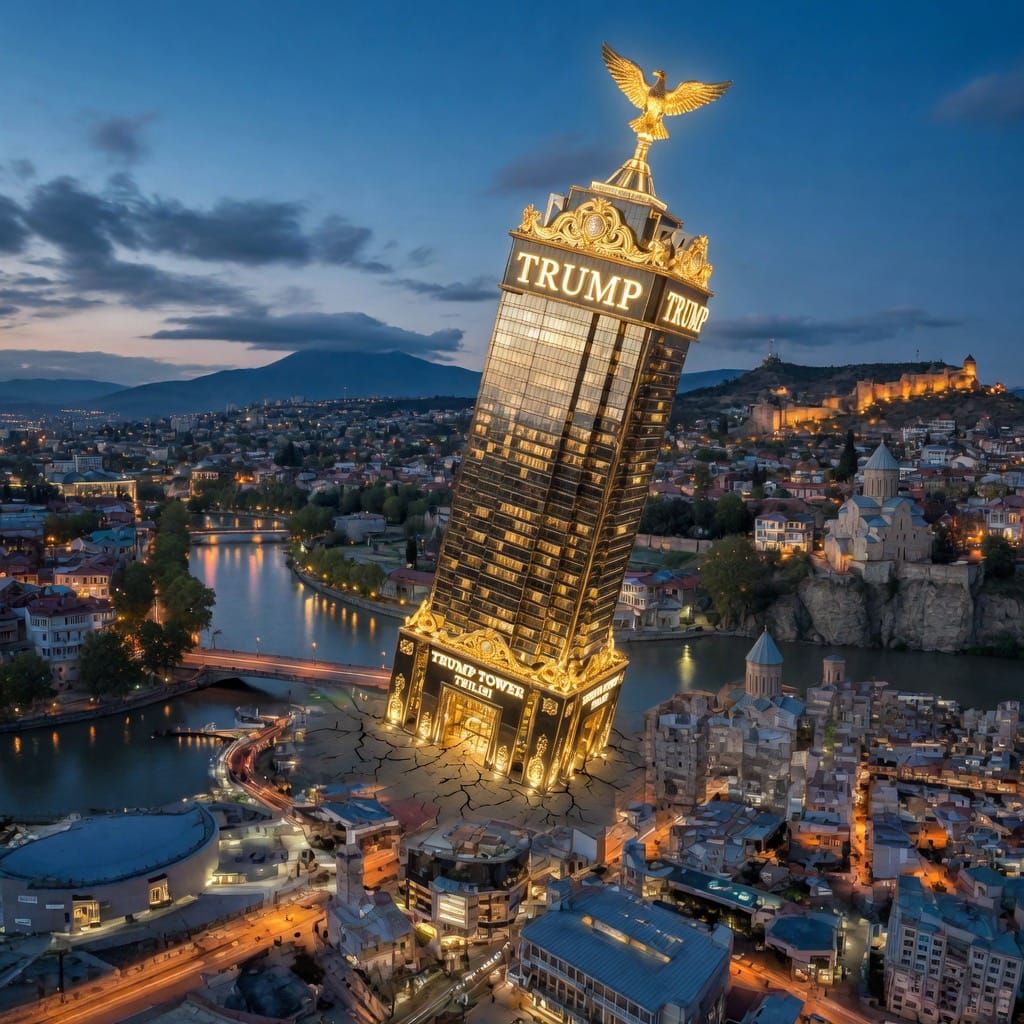
The announcement broke on a Saturday, as these things tend to do: quietly enough to blunt the news cycle, loudly enough to register. The Trump Organization has signed on to build a 70-story luxury tower in Tbilisi, Georgia, partnering with a consortium of local developers and the New York-based Sapir Organization. Gensler is designing it. Eric Trump called it a continuation of the family’s “globally recognized standard of excellence.” The press release described Georgia as a country “drawing comparisons to emerging luxury destinations such as Lisbon and early-stage Dubai.” The tower, if built, would be the tallest structure in the Caucasus.
It would also be the second time the Trump Organization has attempted to plant a flag in Georgia, and the first time it has done so while Donald Trump sits in the Oval Office.
The earlier attempt, announced in 2012 for a site in Batumi, collapsed by January 2017. The official explanation was a voluntary withdrawal to avoid conflicts of interest as Trump prepared to assume the presidency. The real story was messier. The deal had been structured through the Silk Road Group, a Georgian conglomerate led by Giorgi Ramishvili, whose ties to regional political figures, and whose proximity to the kind of transactional relationships that draw scrutiny under the Foreign Corrupt Practices Act, made the project a liability the moment Trump won the election. Investigators and journalists noted that the Trump Organization had, characteristically, done minimal due diligence on its partners. The project wasn’t killed because anyone developed a conscience. It was killed because the optics had become untenable and the legal exposure was real.
That the abandoned project eventually became the Silk Tower, now under construction under the auspices of Georgian Dream founder Bidzina Ivanishvili’s Georgian Co-Investment Fund, is a detail worth holding. Ivanishvili is among the most consequential and controversial figures in post-Soviet Georgian politics: a billionaire who made his fortune in Russia, returned to Georgia to found a political movement, and has since presided over a country that has drifted uncomfortably back toward Russian influence while nominally pursuing EU membership. That his fund absorbed the wreckage of the Trump-Batumi deal, and that the Trump Organization is now returning to Tbilisi with a new set of Georgian partners, raises questions about what kind of country Georgia currently is and what kind of political economy a Trump-branded skyscraper would be entering.
The new partner roster is materially different from 2012. Archi Group, Biograpi Living, Blox Group, and Finvest Georgia replace the Silk Road Group, and the Sapir Organization brings a track record of prior Trump collaboration in New York. There is no Ramishvili. There is, for the moment, no obvious FCPA tripwire. If you are inclined to give the deal the most charitable reading, the partner swap represents exactly the kind of corrective response that critics of the earlier arrangement demanded: new counterparties, a marquee international architecture firm, a more transparent deal structure.
But charitable readings have a poor track record with Trump Organization international transactions, and the structural problem here runs deeper than any specific partner’s biography. The problem is that the Trump Organization is now doing international licensing and branding deals at an accelerating pace: Australia in February, Tbilisi in April, towers previously announced in Dubai, Qatar, Vietnam, India, and Serbia, all while Donald Trump is simultaneously conducting American foreign policy toward every one of those countries. The deals are held in a trust managed by his children; Eric Trump regularly asserts that the family business is walled off from government; and the administration has shown no interest in the kind of divestiture that ethics lawyers have consistently argued the situation demands. Whatever the legal architecture, the practical reality is that foreign governments and their affiliated business communities know that putting money into a Trump-branded project is a way of maintaining a relationship with the American presidency. The trust is a formal distinction. It is not a functional one.
Georgia is a particularly pointed case. The country is at a genuine inflection point, one of the more consequential in its post-Soviet history. The Georgian Dream government has in the last year cracked down on civil society, passed a foreign agents law modeled on Russian legislation, postponed EU accession talks, and overseen a political crisis that sent tens of thousands of protesters into the streets of Tbilisi. The EU has suspended accession negotiations. The United States has imposed targeted sanctions on Georgian officials. Against this backdrop, with Washington actively pressuring Tbilisi on rule-of-law grounds, the Trump Organization’s arrival with a luxury tower and four local development partners is not a neutral commercial event. It is a signal. It suggests that whatever the State Department’s formal posture toward Georgian Dream, there are channels of engagement and benefit available to those who understand how the current American presidency actually works.
This is not a conspiracy theory. It is a description of incentive structures. Authoritarian-adjacent governments across the post-Soviet space have learned to read the difference between American declaratory policy and American revealed preference. A Trump tower is, among other things, a form of revealed preference. It communicates that the family of the American president has decided that Tbilisi is a good place to do business, which in the current environment is a form of political endorsement that no State Department démarche easily countermands.
There is also a narrower irony worth noting. The Trump Organization’s press release describes Tbilisi as “particularly attractive to international investors and second-home buyers” and celebrates Georgia’s wine heritage and emerging hospitality sector. These are the talking points of a Georgian tourism board, not the due diligence of a developer entering a country whose government is currently sanctioned by its own partners. The gap between the marketing language and the geopolitical context is not accidental. It reflects a long-standing Trump Organization practice of treating international real estate licensing as a brand exercise rather than a business judgment, offloading the hard questions of local politics and legal exposure onto partners who, in exchange for the branding premium, absorb the risk. It worked in New York in the 1980s and 1990s. Its international record is spottier.
The 2017 withdrawal was, at least, an acknowledgment that the presidency and the business could not coexist without embarrassment. What is striking about the Tbilisi announcement is the complete absence of that acknowledgment. The Trump Organization is not operating as though conflict of interest is a constraint. It is operating as though conflict of interest is no longer a relevant category. That is the thing that has actually changed since 2017: not the partners, not the architecture firm, not the city. The normative framework that once made the original Batumi deal politically untenable has been dismantled, and in its place is an administration that has decided, as a matter of operating principle, that the president’s family is entitled to do business wherever the business is good.
The tower may or may not get built. Georgian real estate has a distinguished history of announced projects that stall, rebrand, and dissolve. But the announcement itself is already doing the work it was designed to do. It tells a particular class of Georgian and international investor who the Trump family considers a legitimate counterparty, and it tells the Georgian government something about how the current American president thinks about their country. Those messages are transmitted regardless of whether a single foundation pour ever takes place. That is, in the end, what a licensing deal is for.